How to Choose the Right Restaurant Tables
Choosing Restaurant Tables Is About More Than Looks
The right restaurant table has to do more than look good. It needs to fit your floor plan, accommodate the right number of guests, work with your seating, withstand daily commercial use, and reinforce the atmosphere you’re trying to create. Here are the five things you need to consider when choosing table tops for your resturant:
- Table height
- Table size and shape
- Layout and seating requirements
- Material and durability
- Design/customization requirements
What type of dining experience are you creating?
Your restaurant concept should guide your table selection. A fast-casual restaurant may prioritize durable, easy-to-clean tables that support high turnover, while an upscale restaurant may place more emphasis on materials, proportions, and design. Consider how guests will use the space, how quickly tables need to turn, and whether you need flexibility for different party sizes. Table size, height, shape, and material should all work together to support both the function and atmosphere of your restaurant.
Full-service dining
Prioritize:
- Comfort
- Longer dwell times
- Standard dining height
- Larger personal space
- Comfortable chair/table relationship
Fast casual and cafés
Prioritize:
- Flexibility
- Efficient footprints
- Smaller tables
- Mix of two-tops and four-tops
- Potential counter-height seating
Bars, breweries and cocktail concepts
Prioritize:
- Bar-height tables
- Counter-height tables
- Smaller footprints
- High durability
Fine dining
Prioritize:
- Comfortable spacing
- Premium materials
- Refined proportions
- High-quality finishes
- Strong visual presence
Restaurants with private events or flexible layouts
Prioritize:
- Tables that can be rearranged
- Modular sizes
- Consistent heights
- Tables that can be combined
Restaurant Table Height: Dining vs. Counter vs. Bar
| Table Type | Table Height | Best For |
| Dining height | 28–30″ | Traditional dining |
| Counter height | 34–36″ | Casual dining, cafés, mixed layouts |
| Bar height | 40–42″ | Bars, breweries, cocktail areas |
Dining-height tables
Dining-height tables are the most versatile option and work with standard dining chairs. They are best suited for traditional full-service restaurants where guests may spend an hour or more at the table. Their familiar height also provides a comfortable setup for longer meals.
Counter-height tables
Counter-height tables typically measure 34–36 inches tall and create a more casual dining experience. They work well in cafés and casual restaurants and can help define different zones within a dining room. Counter tables are particularly useful near windows, bars, and open kitchens where a change in height can add visual variety.
Bar-height tables
Bar-height tables typically measure 40–42 inches and are paired with bar stools. Their taller profile creates a more social, casual atmosphere and works well in cocktail lounges, breweries, and dedicated bar areas. They can also be useful where space is limited because their smaller footprint allows for additional seating without requiring a full-size dining table.
Should you mix table heights?
Yes. Combining dining, counter, and bar-height tables can create visual hierarchy and give different areas of the restaurant distinct functions. Use standard dining tables for longer meals, counter-height tables for casual seating or defined zones, and bar-height tables for social areas or smaller footprints. Mixing heights can also add variety to the dining room without requiring different furniture styles throughout the space.
How to Choose the Right Restaurant Table Size
Start with the number of guests
Start by determining how many guests each table needs to accommodate.
2-tops offer flexibility for smaller parties and can be combined for larger groups, while 4-tops are the most common configuration for standard dining.
6-tops and 8-tops accommodate larger parties but require more floor space and can be less flexible when demand is primarily for smaller groups.
Communal tables can provide efficient seating for larger groups while creating a shared dining experience. Rather than maximizing table size, balance guest capacity, comfort, circulation, and service efficiency to create a layout that works for both guests and staff.
Common restaurant table dimensions
| Shape | Common Size | Typical Seating |
| Round | 24″ | 2 |
| Round | 30″ | 2 |
| Round | 36″ | 3–4 |
| Round | 40″ | 4–6 |
| Square | 24″ x 24″ | 2 |
| Square | 30″ x 30″ | 2–4 |
| Rectangle | 30″ x 48″ | 4 |
| Large rectangle | Custom | 6+ |
Don’t forget tabletop usable space
Table dimensions need to account for more than the number of guests. Each place setting needs room for plates, glassware, and utensils, while shared dishes, condiments, or centerpieces require additional surface area. Cafés should also consider whether guests will use tables for laptops or work. A table that technically fits the right number of guests can still feel cramped if there is not enough usable space for the way guests will actually use it.
Round vs. Square vs. Rectangular Restaurant Tables
Round tables
Best for:
- Conversation
- Intimate dining
- Smaller groups
- Breaking up rigid layouts
Square tables
Best for:
- Two- and four-top configurations
- Modular layouts
- Combining tables
- Efficient floor plans
Rectangular tables
Best for:
- Larger groups
- Banquets
- Communal dining
- Long spaces
- Maximizing seating along walls
Custom shapes
Examples include:
- Curved
- Racetrack
- Irregular
- Specialty shapes
- Tables designed around columns, walls or architectural elements
How Much Space Do You Need Between Restaurant Tables?
The space between tables needs to account for more than the table itself. Allow room for chairs to pull out, servers to move between tables, and guests to enter and exit their seats without disrupting nearby diners. As a starting point, plan for roughly 24–30 inches between table edges, 18–24 inches of chair clearance, and at least 36 inches for aisles, with 48 inches preferable for busy traffic areas. These are planning guidelines, not universal code requirements, so verify your final layout against applicable building and accessibility requirements.
Don’t design solely around maximum seating
Adding more tables does not necessarily mean more revenue. If servers cannot move efficiently or guests feel cramped, a higher seat count can negatively affect the dining experience and service. The goal is to maximize usable capacity, not simply the number of tables. A well-planned layout gives guests enough room to move comfortably while allowing staff to serve efficiently.
What Material Is Best for Restaurant Tables?
Solid wood
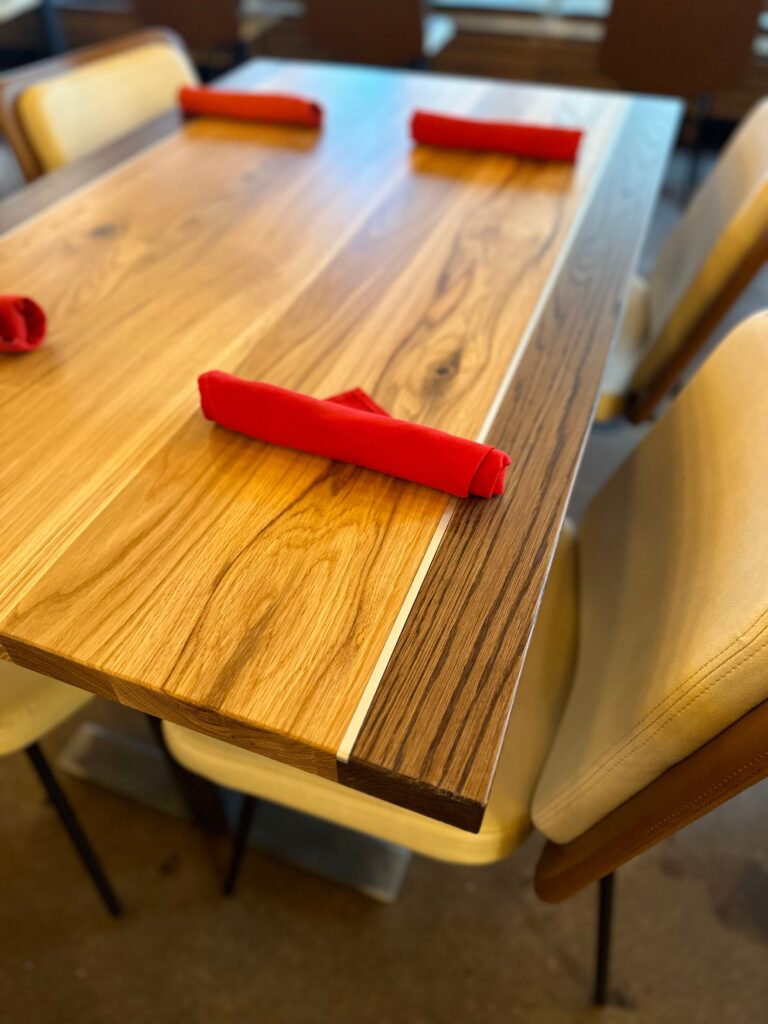
Solid wood brings warmth, natural variation, and a premium appearance to a restaurant. It can be finished in a wide range of colors and sheens and can be customized to fit the restaurant’s design. With proper care, solid wood tables can also be refinished or repaired over time, extending their useful life.
Metal
Metal offers durability and a more industrial or modern appearance. It works well in high-traffic environments and can be used for table frames and bases. Metal can also be combined with wood to balance durability and structure with the warmth and appearance of natural wood.
Wood + Metal
Combining wood and metal allows you to use the strengths of both materials. Wood provides warmth and visual character, while metal adds structural strength and durability. This combination also offers flexibility in the overall design, from simple wood tops with metal bases to more integrated custom table designs.
Choosing the Right Table Base
Pedestal bases
Advantages of pedestal bases include:
- More legroom
- Easier chair placement
- Good for round tables
- Flexible seating
Four-leg bases
Advantages of four-leg bases:
- Familiar
- Stable
- Traditional appearance
- Works across many table sizes
Metal bases
Advantages of metal bases:
- Modern appearance
- Structural support
- Design opportunity
- Can accommodate unusual tabletop dimensions
Custom bases
Advantages of custom bases:
- Unique to your restaurant bases
- Mixed material designs
Base placement matters
How Durable Should Restaurant Tables Be?
Restaurant tables need to withstand constant cleaning, spills, heat, scratches, impacts, and frequent movement. They are used heavily every day, with guests repeatedly sitting, standing, and moving around them. When selecting tables, ask the manufacturer what materials, construction methods, and finishes are designed for commercial use and how they are expected to perform over a long service life.
Finish matters as much as material
The finish protects the table from many of the conditions that cause premature wear. Ask about the type of protective finish being used, how well it resists scratches and stains, and what cleaning products and procedures it can withstand. A properly sealed surface and commercial-grade finish can make a significant difference in how a table holds up to daily restaurant use. For wood tables in particular, ask whether the finishing system is designed specifically for the demands of a commercial environment rather than residential use.
When Should You Choose Custom Restaurant Tables?
Custom isn’t automatically better for every restaurant. Standard tables may be the right choice when you need a straightforward solution, have a flexible layout, or are working within a tight budget. Custom restaurant tables make more sense when standard sizes, materials, finishes, or designs don’t meet the requirements of your space. Consider custom tables when you need unusual dimensions, specific finishes or materials, unique designs, or tables that coordinate with other elements of the restaurant. Custom manufacturing also gives you more control over table height, edge details, bases, and construction, allowing the furniture to fit the space and perform the way your restaurant requires.
Standard tables make sense when:
- Budget is the primary concern
- Dimensions are conventional
- The project has a short timeline
- You need a large quantity of identical pieces
- Design differentiation isn’t important
Custom tables make sense when:
- The space has unusual dimensions
- You need specific table sizes
- The furniture needs to match the brand
- You want unique materials
- You need specialized shapes
- You need a specific finish
- The table needs to integrate with booths or banquettes
- You’re outfitting a high-end hospitality space
Is Custom Restaurant Furniture Worth the Cost?
Custom isn’t automatically better for every restaurant. The value depends on whether the additional cost solves a specific problem or provides a meaningful advantage over a standard product.
Upfront price vs. lifecycle value
Instead of comparing tables by purchase price alone, consider the total cost over their useful life. Factor in purchase price, replacement frequency, maintenance, downtime, and design compromises. A lower-cost table may make sense initially, but frequent replacement or repairs can increase its long-term cost.
Customization has practical value
Customization isn’t just about appearance. Custom restaurant tables can solve awkward dimensions, specific seating requirements, unusual base placement, material requirements, and the need for consistent furniture across a restaurant or multiple locations. The goal is not simply to make a table different, but to make it fit the space, function, and requirements of the restaurant.
Your Tables Should Work With the Rest of the Space
Restaurant tables should coordinate with the rest of the space, including chairs, booths, banquettes, bar tops, lighting, flooring, wall finishes, and the overall brand identity. The table doesn’t need to match every element, but its materials, proportions, and finish should feel intentional within the restaurant’s design.
Match materials strategically
Choose materials that support the atmosphere you’re creating. A warm restaurant may pair natural wood tables with upholstered seating, while a modern concept may use slim profiles, metal, and clean finishes. An upscale restaurant may favor premium hardwood and refined bases, while an industrial concept can combine wood with steel and exposed structural details.
Restaurant Table Buying Checklist
Before ordering make sure to determine the following:
- Restaurant concept
- Number of guests per table
- Table height
- Table dimensions
- Table shape
- Floor-plan constraints
- Required circulation space
- Seating type
- Tabletop material
- Base style
- Finish
- Cleaning requirements
- Expected level of use
- Required quantity
- Custom dimensions
- Lead time
- Budget
- Future replacement/maintenance needs
Frequently Asked Questions About Restaurant Tables
What is the standard height for a restaurant table?
Typically 28–30″.
What is the difference between dining height and counter height?
28–30″ vs. 34–36″.
What height is a bar table?
Typically 40–42″.
What size table seats four people?
The right size depends on the table shape and how much usable space each guest needs. Common options include 36–48-inch round tables and rectangular tables around 30 × 48 inches. Consider plate, glassware, and serving space in addition to simply fitting four chairs.
What is the best material for restaurant tables?
There is no single best material for every restaurant. Consider durability, maintenance, appearance, and budget when choosing between wood and metal. The right material should match the restaurant’s design while withstanding the demands of daily commercial use.
Are custom restaurant tables worth it?
Custom tables are worth considering when standard products cannot meet a specific design or operational requirement. Customization can solve issues such as unusual dimensions, seating requirements, base placement, material selection, or the need to maintain a consistent design throughout the restaurant.
How much space should be between restaurant tables?
As a general planning guideline, allow roughly 24–30 inches between table edges, with about 18–24 inches for chair clearance and at least 36 inches for aisles. Busier traffic areas may benefit from closer to 48 inches. Final layouts should always be reviewed against applicable building and accessibility requirements.
What type of restaurant table is best for a small space?
Two-tops, square tables, and counter-height tables can work well in smaller dining areas. Flexible configurations are also useful because smaller tables can be combined when needed while remaining efficient for smaller parties.
Build Restaurant Tables Around Your Space
You shouldn’t have to design your restaurant around whatever table happens to be available. SouthLoft builds commercial restaurant tables around your dimensions, seating layout, materials, finishes, brand, and operational requirements. Whether you need specific table sizes, custom finishes, or a consistent design across your dining space, the goal is to build furniture that fits the restaurant rather than forcing the restaurant to fit the furniture.